What We Research
The Center for Climate Change and Health Equity's researchers focus on understanding and addressing the health impacts of climate change, developing innovative interdisciplinary solutions to protect vulnerable populations, and improving health equity and environmental resilience.

Kelly K. Baker’s research aims to ensure young children globally are born healthy and grow and develop protected from malnutrition and infectious diseases. Lack of access to basic needs, like clean water and food, sanitation and wastewater systems, and housing places low-income families and communities at higher risk for adverse birth outcomes and infectious diseases, making this an environmental justice issue.
Unhygienic living conditions also cause infections in domestic companion and food production animals, facilitating transmission of zoonotic diseases between humans and their animals. Increases in severe weather events like flooding and drought fueled by climate change make prevention of these environmental and zoonotic issues even more difficult.
Baker’s work focuses upon identifying climate-resilient infrastructural, social, and public health interventions that protect the health all children from birth through early childhood alongside and through the protection of animal and ecological health.
Her current projects include:
- Global development, urban flooding, and diarrheal disease in Kenya
- Drought, rurality, and foodborne disease and malnutrition in Ethiopia
- Flooding, drought and well water microbial pollution in Iowa
- Seasonality, human and animal movement, and guinea worm ecology in Ethiopia
- Water insecurity, gender, and maternal and child health in India
- Rapid point-of-care diagnostics for waterborne diseases in Bangladesh, Kenya, and Iowa

- Yamamoto, S.S., Lowe, S., Denier, N., Pabayo, R., Wu, H., St. Dennis, F., (2023-2024), LGBTQIA+ Communities and Climate Change: An Exploratory Study. Canadian Institutes for Health Research.
- Yamamoto, S.S. (PI), Denier, N., Lowe, S., Pabayo, R., Wu, H., St. Dennis, F., (2023-2024), Understanding the Perceptions and Health Impacts of Climate Change among LGBTQIA+ People in Alberta: A Mixed- Methods Pilot Study. Canadian Institutes for Health Research.
- Yamamoto, S.S. (PI), Bulut, O., Jones, A., Liang, H., Osornio Vargas, A., Salma, J., Whitfield, K., (2022-2023), Preparing cities for climate change. Canadian Institutes for Health Research.
- Yamamoto, S.S. (PI), Osornio Vargas, A., Jones, A., Bulut, O., Hanson, W., Lavigne, E., Randall, J., Salma, J., Stieb, D., Svenson, L., Voaklander, D., N. Yiannakoulias, N., Read, A., Sharpe, H., Turtiak, M., (2020-2024), Climate change surveillance for chronic health effects in populations. Public Health Agency of Canada.
Learn more about CHEER, the Climate Health and Environment Epidemiology Research Lab.

Kristen Cowan’s research investigates how social systems, and environmental hazards interact to shape health disparities, with a focus on climate change and disasters. Her work aims to identify and address the underlying drivers of vulnerability to climate-related health impacts, especially among incarcerated populations, minoritized communities, and people with chronic illnesses or limited resources.
Kristen Cowan uses methods from environmental epidemiology and social epidemiology to measure how exposure to extreme heat, wildfire smoke, flooding, hurricanes and other disasters influence health outcomes. She also evaluates how social policies and infrastructure influence the distribution of environmental risks and how we can reduce health inequities in the face of worsening climate events.
Her current projects include:
- Wildfire smoke exposure and poor health outcomes among incarcerated people in California
- Utility burden, extreme heat, and birth outcomes in the United States
- Structural barriers in disaster preparedness for incarcerated populations
- Development of an improved vulnerability index for climate hazards
- Assessment of extreme heat metrics in epidemiology studies

Mark M. Janko conducts research at the intersection of the Planetary Boundaries and Health. He primarily focuses on questions of land use and land system change and how they intersect with demographic processes to influence vector-borne and other infectious disease outcomes. He conducts most of his work in tropical ecosystems such as the Amazon and Congo Basins, as well as Madagascar and Panama. Mark trained in Geography and Biostatistics and leverages hierarchical Bayesian spatio-temporal methods to address questions on the impacts of human-environment interactions and their impact on health.
Current Projects:
- Understanding how human mobility and hydrometeorology along the Amazon river system influences the spread of malaria and other infectious diseases.
- Understanding how land system change, market integration, and climate adaptation influence emerging infectious diseases in the Amazon, Congo, and Madagascar.
- Development of Climate-informed Early Warning Systems to transform infectious disease surveillance systems from reactive to proactive, anticipating outbreaks or changes in case rates before they occur.

Joshua Miller’s research examines how environmental risks and resource insecurities – particularly those related to water, sanitation, and hygiene (WASH) – contribute to health disparities across the life course. Drawing on methods from nutrition, epidemiology, and the social sciences, his work explores how individuals perceive and respond to WASH challenges, and how these experiences shape behaviors and outcomes related to diet, mental health, and chronic disease. Central to his work is the development and application of tools that capture people’s lived experiences, including the Water Insecurity Experiences (WISE) Scales.
Safe water is essential for health and well-being, yet billions of individuals lack reliable access to this fundamental resource. Water-related challenges can disrupt food production and preparation, caregiving practices, and hygiene routines; increase psychosocial stress; and undermine long-term health. Water insecurity is both a driver and a consequence of broader social inequities, disproportionately affecting low-income households and communities most exposed to climate-related hazards – thus making it a critical environmental justice issue.
A growing area of Miller’s research is on WASH adequacy in institutional settings, including schools and healthcare facilities. He co-leads a global consortium developing user-centered metrics that aim to complement traditional supply-based indicators and inform more equitable, climate-resilient public health interventions.
Current projects include:
- Development and validation of the Institutional WASH Experiences (INWISE) Scales, with ongoing work in Ethiopia, Kenya, Malawi, Mozambique, Nepal, Peru, Rwanda, and Uganda
- Examining how water insecurity affects diet, infant and young child feeding, and risk of diet-related disease
- Investigating how climate change and WASH challenges shape adolescent health and development in the Philippines
- Synthesizing evidence on how food insecurity influences caregiver and child health during the first 1,000 days and beyond
- Studying how workplace conditions impact hydration practices and kidney health among workers in Western New York


Jordan Giese, PhD, MPA
Postdoctoral Associate, Center for Climate Change and Health Equity
Research Topics: Environmental Justice; Native politics and resilience; Contamination politics; Traditional Knowledge Systems; Water system health and integrity; Impacts of industry, resource extraction, and militarism
Farber 172A
Phone: (716) 829-5976
jgiese@buffalo.edu
Jordan Giese’s research focuses on Indigenous health and sustainability in the face of growing concerns over resource extraction related to rare earth minerals and radioactive contamination. Their work highlights Native voices in a rapidly changing federal and global environment as Native Nations work to responsibly govern and steward land.
Jordan utilizes a mixed methods approach, from qualitative research interviewing current residents to spotlight current concerns while also bringing historical materials forward to show the lesser seen temporal and spatial dimensions of environmental contamination. This work is designed to inform policy at the local, national, and international level to better protect Indigenous health and culture.
Their current project include:
- Outreach to the Tonawanda Seneca about threats to the Big Woods and local water supplied from construction and development
- Development of heat mitigation plans across different community aid programs in the Greater Buffalo area


Andrew Hopkins, PhD
Postdoctoral Associate, Center for Climate Change and Health Equity
Research Topics: Disease Ecology, Epidemiology, Ecotoxicology, Aquatic Toxicology, and Wetland Ecology
Farber 172A
ah272@buffalo.edu
Andrew’s research examines how both community ecology and contaminant exposure interact and influence the spread and persistence of pathogens. His work focuses on how species respond to simultaneous exposure to pathogens as well as environmental contaminants ranging from heavy metals to pesticides.
Andrew’s research approach focuses on both controlled laboratory studies as well as field-based environmental research. He seeks to implement the ONE Health approach to his research combining to better understand the role that environmental changes influence species interactions and pathogen spread.
Current and Past Projects:
- Use of leeches as a substitute for blood draws in measuring American Alligator exposure to PFAS
- Effects of landscape level effects on PFAS contamination in amphibians and reptiles
- Environmental DNA as a method to measure and track the spread of Avian Influenza
- Environmental factors that influence guinea worm persistence and spread


Ellie Madson, MPH
Lab Manager; Dr. Kelly Baker's Research Team
Research topics: One Health, water insecurity, water quality, policy evaluation, community-based participatory research, rural health
115 Biomedical Research Building
Phone: (716) 829-6276
Email: elliemad@buffalo.edu

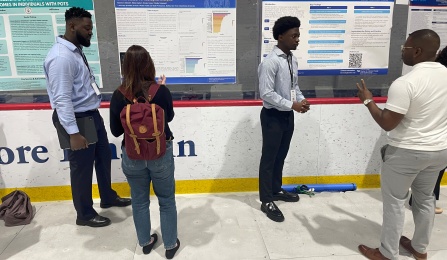
Students Kevin Boasiako and Olufemi Adewole represented the Center for Climate Change and Health Equity (CCCHE) at the New York State Public Health Association (NYSPHA) 2026 Annual Conference in Lake Placid, N.Y. In collaboration with faculty from CCCHE, they presented on disaster preparedness in New York State along with new climate education tactics for youth in Western New York.

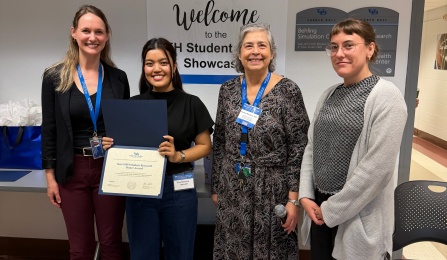
Student Eliza Manhring won the "Best MPH Student Research Poster Award (Epidemiology concentration)" for her poster Resilience in Action: Strengthening Disaster Preparedness for People Who Are Incarcerated at the Department of Epidemiology and Environmental Health's Spring 2026 EEH MPH Culminating Projects Showcase. Manhring was mentored by Center faculty Dr. Kristen Cowan and EEH Faculty Dr. Robyn Cree.
CCCHE PhD student Tahmidul Haque published "Mapping One Health antimicrobial resistance policy and implementation in Bangladesh: A scoping review" in One Health.

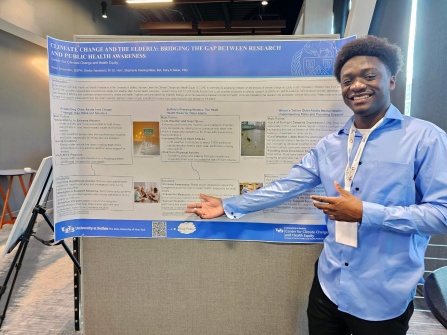
Sophomore Kevin Boasiako presented this poster at the New York State Public Health Association’s 76th Annual Meeting in Ithaca, N.Y. This poster is inspired by the blog that Kevin wrote for the Center for Climate Change and Health Equity. This work was a part of the School of Public Health and Health Professions’ Undergraduate Research Experience. Kevin’s work as part of the ongoing “Climate Stories You Should Know” project sought to translate research into action for climate vulnerable communities.
Stories You Should Know
Read the latest updates on CCCHE here.