UB hosting 5th annual Refugee Health Summit on April 20

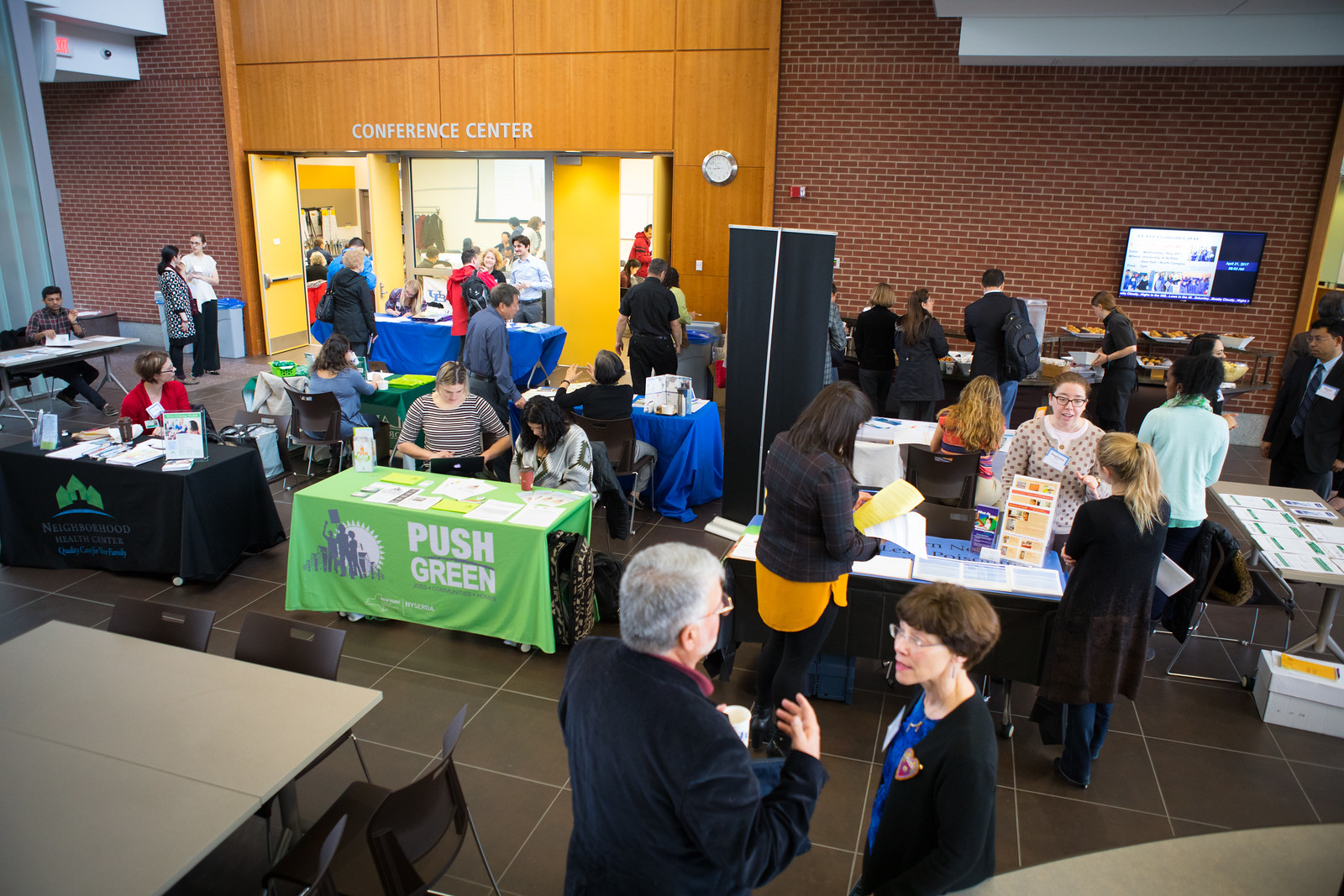
The scene at the 2017 Refugee Health Summit. Photo: Douglas Levere
Release Date: April 18, 2018 This content is archived.
BUFFALO, N.Y. — The University at Buffalo will host its fifth annual WNY Refugee Health Summit this Friday, April 20, from 8:30 a.m.-4 p.m. at the Arthur O. Eve Educational Opportunity Center, 555 Ellicott St., Buffalo.
The summit unites 150 clinicians, resettlement caseworkers, community health workers, researchers, students, municipal leaders and refugees to understand the many factors affecting health and well-being for refugee populations in Buffalo.
These factors include access to culturally and linguistically appropriate services, efficient clinic and transportation systems and operations, and available economic opportunities.
Buffalo has a unique history – as far back as the mid-1800s – of welcoming communities that are escaping famine, war and political strife.
Today, Erie County resettles the highest number of refugees in New York State, which is the third highest resettlement state in the U.S., after California and Texas. Buffalo’s New Americans are contributing to a housing boom and economic development, according to a report published last year by New American Economy.
However, they are living amidst great uncertainty. The reduction to the number of refugees resettled in the United States during 2017 has split families apart. Increases in gun violence are re-traumatizing communities escaping violence and fear while hate crimes and bias are on the rise.
Buffalo’s care providers – clinicians, nurses, pharmacists, social workers and lawyers, among others – must deliver appropriate care to populations representing numerous religions, cultural and ethnic traditions, and languages.
“The University at Buffalo seeks to create positive change within our local and global populations. We have a unique position to play in understanding the intricacies of health and well-being for our New American neighbors, populations facing continued uncertainty and fear,” said Pavani Ram, co-director of UB’s Community for Global Health Equity.
“Our partnerships have led to important studies illustrating the diverse factors that affect refugee health and well-being including the diversity of food environments, efficiencies of clinic operations, access to cultural and linguistic care and resources, cultural nuances related to mental health, and youth empowerment,” Ram added.
UB’s Refugee Health Summit will highlight these partnerships.
The summit will begin with a welcome from Jo Freudenheim, chair of epidemiology and environmental health in UB's School of Public Health and Health Professions; Pavani Ram, co-director of the Community for Global Health Equity; and Lina Mu, director of SPHHP's Office of Global Health Initiatives.
A series of town hall discussions will take place throughout the day, featuring presenters and panelists from a mix of schools at UB, as well as representatives from community and governmental organizations directly involved with refugee health and well-being.
Topics include building culturally competent environments; improving clinic operations; improving mental health care; strategies for reducing Medicaid processing gaps; and programs and issues that impact younger refugees.
The summit is co-sponsored by UB’s Community for Global Health Equity and the Office of Global Health Initiatives.
Media Contact Information
David J. Hill
Editor, UBNow
Tel: 716-645-4651
davidhil@buffalo.edu