Opioid crisis: UB researcher hopes to provide clues on women’s shift to heroin
Release Date: October 31, 2018 This content is archived.

BUFFALO, N.Y. — A growing number of women in the U.S. are turning to heroin after first taking prescription opioid medication. This places them at greater risk for HIV and hepatitis C, and for spending time in the court system.
Scientists, however, have little insight into why this is happening. A University at Buffalo researcher, with colleagues from Columbia University and the University of Rochester, has received funding to provide some clues by working with a unique drug treatment court (DTC) in Buffalo.
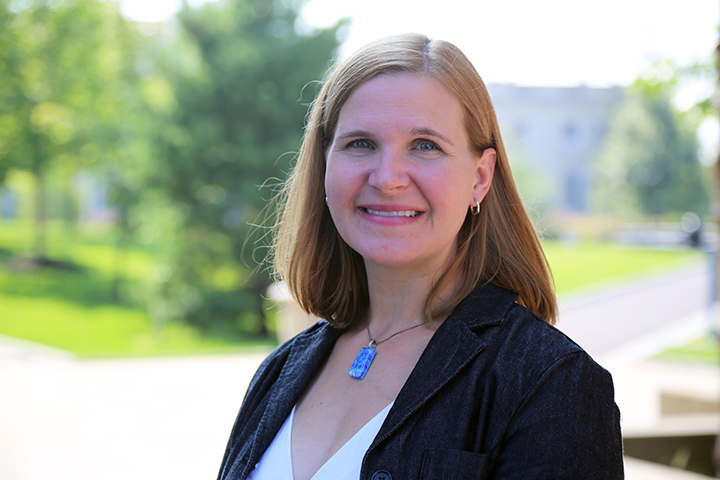
Sarahmona Przybyla, PhD, an assistant professor of community health and health behavior in UB’s School of Public Health and Health Professions, was awarded $30,000 through the University of Rochester Center for AIDS Research (CFAR) for the 10-month project. Przybyla’s co-principal investigator is Diane Morse, MD, an infectious disease physician at the University of Rochester.
The script was flipped between the 1960s and early 2000s, according to federal data from the National Institute of Drug Abuse. Of people entering treatment for heroin addiction in the 1960s, more than 80 percent began with heroin. In the 2000s, 75 percent of people being treated for heroin addiction started with a prescription opioid.
Women also dramatically increased their use of opioids during this time period. In the 1960s, 82 percent of those seeking treatment were men. By 2010, there was near equal representation of women.
There is little information on the specific driving forces and trajectories for the increase in women progressing from using pain medication to heroin, according to Przybyla. In addition, she says, there is limited understanding of their related paths to recovery, correlating HIV risk behaviors and treatment, and reproductive health outcomes.
“This study aims to shed light on these poorly understood and critically important questions as part of a concerted strategy to improve substance use disorder outcomes and decrease HIV infections,” says Przybyla.
Researchers are working with Judge Craig Hannah and Treatment Court Liaison Jeff Smith of Buffalo City Court’s Opiate Crisis Intervention Court. It’s an experimental court — the first of its kind in the country — that directs nonviolent opioid offenders toward treatment instead of jail.
“Given the needs of women in drug treatment court and the lack of knowledge regarding women with opioid use disorder who progressed to heroin from prescription pills, this court represents a unique opportunity to combine the complementary expertise of University of Rochester, University at Buffalo and Columbia University co-investigators,” Przybyla said.
Researchers will interview female opioid track DTC participants to learn more about their life experiences with substance use and recovery, as well as HIV-related preventive behaviors and reproductive health experiences.
The results will inform both medical and criminal justice systems about substance use disorders, medical and trauma-related needs of women with opioid use disorders. Przybyla and Morse hope to extend the results of this pilot study to other opioid court programs in other parts of Western New York.
Przybyla adds that the project team comprises a unique group of experts in a variety of fields, including public health, infectious diseases,
Media Contact Information
David J. Hill
Editor, UBNow
Tel: 716-645-4651
davidhil@buffalo.edu