Overview

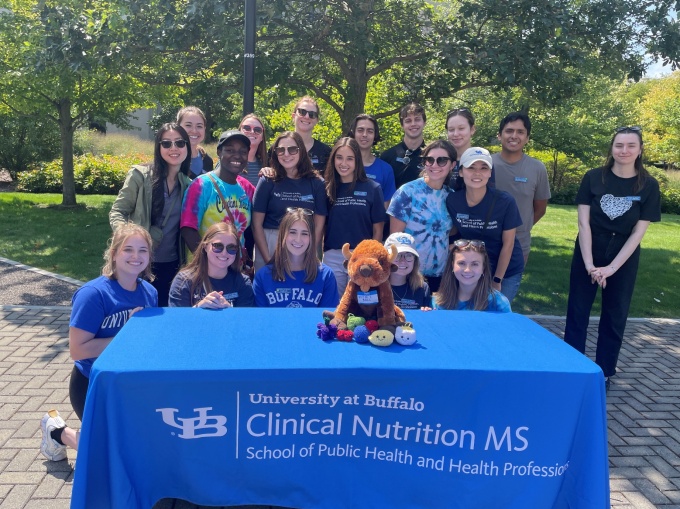
A two-year integrated program at the graduate level that provides didactic and experiential learning in one unified program, leading to the Registered Dietitian Nutritionist (RDN) credential.
On This Page
UB's Clinical Nutrition MS program provides all the requirements to prepare you to become a Registered Dietitian Nutritionist. The Commission on Dietetic Registration (CDR) requires that students complete graduate coursework and supervised experiential learning in a program accredited by the Accreditation Council for Education in Nutrition and Dietetics (ACEND) in order to sit for the Registered Dietitian Nutritionist national examination.
UB’s graduate program meets CDR’s requirements with a robust education and training program that brings together students from varied backgrounds and combines graduate coursework and experiential learning to develop the next generation of registered dietitian nutritionists.
The program builds on the history and success of UB’s Dietetic Internship, which was the first and only dietetic internship in Western New York. We have trained future registered dietitian nutritionists for excellence, innovation and leadership since 1999.
Steps to becoming an RDN
- Academic preparation. Earn any bachelor’s degree and complete prerequisite coursework.
- Apply to UB. Complete experiential learning and graduate degree accredited by ACEND (Accreditation Council for Education in Nutrition and Dietetics).
- National exam. Pass the entry-level registration (credentialing) examination administered through the Commission on Dietetic Registration.
- State licensure/certification. If applicable, apply for state licensure.
You have a maximum of three years to complete the program, which will include:
- Successful achievement and documentation of all scheduled supervised experiential learning hours.
- A minimum “acceptable mastery” rating on all evaluations from all preceptors in all rotations and all competencies.
- All assignments submitted and deemed acceptable; all evaluation forms submitted.
Eligibility for Registration Exam
Once you have earned your Master of Science in Clinical Nutrition from UB, you will receive a verification statement to sit for the national registration examination for dietitians, administered by the Commission on Dietetic Registration (CDR).
The UB Clinical Nutrition Program prepares graduates to become competent, entry-level registered dietitian nutritionists for service and practice through educational excellence, interprofessional collaboration, use of the research process and critical thinking skills to improve the health of populations, communities and individuals.
- Program graduates will be competent, entry-level registered dietitian nutritionists serving the nutrition needs of populations, communities and individuals.
- At least 80% of program students complete program requirements within 3 years (150% of the program length)
- At least 90% of program graduates take the CDR credentialing exam for dietitian nutritionists within 12 months of program completion.
- The program’s one-year pass rate (graduates who pass the registration exam within one year of the first attempt) on the CDR credentialing exam for dietitian nutritionists is at least 80%.
- Of graduates who seek employment, 80% are employed in nutrition and dietetics or related fields within 12 months of graduation.
- 90% of employers who respond to the Employer Survey rate the graduate as a 4 (good) on a scale of 1-5 on entry-level competency for practice.
- 90% of graduates who respond to the One Year Graduate Survey rate themselves as a 4 (high) on a scale of 1-5 on their ability to serve the nutrition needs of populations, communities and individuals.
- Program graduates will participate in interprofessional collaboration and apply an evidence-based approach to practice..
- 90% of graduates who respond to the One-year Graduate Survey routinely use current research findings in professional practice.
- 90% of graduates who respond to the One-year Graduate Survey report participating in interprofessional practice activities.
Program outcomes are available upon request.