Master of Science in Strength and Conditioning
Train athletes at the highest level. Complete your degree in just one year!

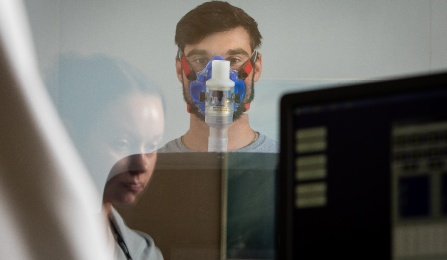
As part of classes, students will practice VO2max testing.
Program Overview
Elevate your career in athletic performance. The Master of Science in Strength and Conditioning at the University at Buffalo is a one-year, three-semester program designed to prepare graduates for professional practice as Certified Strength and Conditioning Specialists (CSCS). Combining rigorous coursework in exercise physiology, biomechanics, sport nutrition, and program design with more than 300 hours of hands-on field experience, our program produces practitioners ready to excel in collegiate, professional, and other clinical settings.
As the only master's-level strength and conditioning program in New York State offered at a SUNY institution, UB provides an affordable, high-quality pathway to one of the fastest-growing fields.
Why UB for Strength and Conditioning?
- Affordable tuition with the quality of a top public research university
- Expert faculty who hold CSCS credentials and bring real-world experience
- State-of-the-art facilities including dedicated strength and conditioning and exercise phyisology labs
- Clinical partnerships with the NFL, NHL and UB's own division 1 athletics
Launch Your Career in Athletic Performance
The demand for qualified strength and conditioning professionals continues to grow across collegiate, professional, and clinical settings. Our program prepares you for the Certified Strength and Conditioning Specialist (CSCS) examination and positions you for success in this competitive field.
Career Opportunities
Graduates are prepared for positions including:
- Strength and Conditioning Coach (collegiate, professional, high school)
- Performance Specialist
- Human Performance Coordinator
- Fitness Director
Employment Settings
- NCAA Division I, II, and III athletic programs
- Professional sports organizations (NFL, NHL, MLB, NBA, MLS, etc.)
- Olympic training centers and national governing bodies
- Private sports performance facilities
- Military and tactical performance programs
- Corporate wellness and fitness centers
- Sports medicine clinics and rehabilitation centers
Student Learning Outcomes
Upon complete of the program, graduates will be able to:
- Identify structures of the musculoskeletal system
- Describe anatomical planes and major body movements
- Describe the biomechanics of resistance and strength training
- Examine and assess joint biomechanics, funcitonal anatomy and human movement
- Generate, analyze, and evaluate strength and conditioning programming
- Identify and contrast adaptations to training programs, including progessive overload, undertraining, and detraining
- Incorporate principles of sport and exercise psychology into programming
- Develop advanced program design for anaerobic, aerobic, and resistance training
- Describe the link between nutrition and exercise performance