Researchers present first clinical proof that individual genotypes determine if Alzheimer's disease drugs will work
UB researchers’ insights into a target that succeeded in animals but failed in humans reveal a new paradigm for screening Alzheimer’s drugs
Release Date: July 17, 2019 This content is archived.

BUFFALO — University at Buffalo researchers have determined that a human gene present in 75% of the population is a key reason why a class of drugs for Alzheimer’s disease seemed promising in animal studies only to fail in human studies.
The researchers say the work suggests that in different Alzheimer’s disease patients, different mechanisms are at work that determine whether or not a given therapy will be effective.
While a previous study by the researchers studied the function of the gene in tissue culture, this is the first time that drug effect based on a patients’ genotype has been clinically shown.
The UB researchers caution that the study has its limitations and randomized double blind studies are needed to confirm the results.
The research was conducted on data from a ten-year, longitudinal, multicenter cohort study by the Texas Alzheimer Research and Care Consortium (TARCC) on 345 Alzheimer’s patients. The UB researchers are collaborators on the TARCC. It was presented at the annual Alzheimer’s Association International Conference (AAIC) held this week in Los Angeles.
Proof of concept
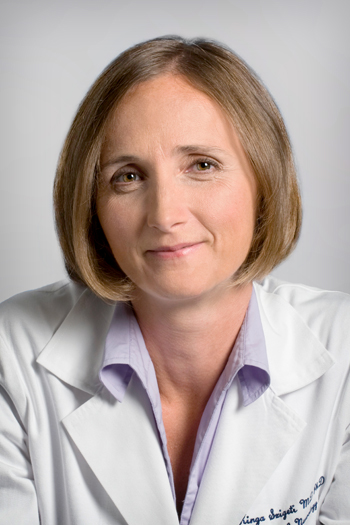
“This research provides proof of concept that since different mechanisms are at work in Alzheimer’s in different patients, we need to develop more personalized treatments that will prove more effective in individuals,” said Kinga Szigeti, MD, PhD, lead investigator, director of UB’s Alzheimer’s Disease and Memory Disorders Center, part of UBMD Neurology, and associate professor of neurology in the Jacobs School of Medicine and Biomedical Sciences at UB.
The gene, CHRFAM7A, is a fusion between a gene that codes for an Alpha 7 receptor for acetylcholine, a neurotransmitter involved in memory and learning and long associated with Alzheimer’s, and a kinase, a type of enzyme.
Szigeti explained that the gene is present in two flavors, a functional gene and one that is not made into protein, data the UB team also is presenting this week at AAIC.
“This splits the population 1-to-3 between non-carriers and carriers,” said Szigeti. CHRFAM7A has been implicated in many neuropsychiatric disorders, such as schizophrenia and bipolar disease.
Szigeti explained that three of the four drugs now available for Alzheimer’s work by stimulating all receptors that respond to acetylcholine. More specific drugs for Alpha 7 have been in development for over 10 years but failed when moved to the clinical phase.
The human fusion gene modulates the Alpha 7 receptor, one of the receptors binding amyloid beta, the protein that is the hallmark of Alzheimer’s that disrupts neuronal communication.
“Since this human fusion gene was not present in the animal models and screening systems used to identify drugs, 75% of Alzheimer’s patients who do carry this gene are less likely to benefit and therefore are at a disadvantage,” she said. “This may account for the translational gap.”
Gene carriers
“With this study, we compared the effect of cholinesterase inhibitors in patients who did or didn’t carry this gene,” said Szigeti. “People who don’t have the gene respond better to the drugs available now.”
She added that neurons vulnerable to Alzheimer’s express Alpha 7 and that may be the reason why they die first.
“Our work confirms that Alpha 7 is a very important target for treating Alzheimer’s but the right model—a human model—has to be used when testing new drugs,” said Szigeti.
The findings suggest that a more personalized approach to each patient may be required, based on their CHRFAM7A genotype. One drug may work in 25% of the patients, while another will work in 75%.
Co-authors with Szigeti are Aya Ouf, MD, research assistant in the Department of Neurology; Joan S. Reisch, PhD, of the University of Texas Southwestern Medical Center; Valory Pavlik of Baylor College of Medicine; Gregory Wilding, PhD, chair and professor, Department of Biostatistics, and Ziquiang Chen, both of the UB School of Public Health and Health Professions.
The work was funded by the Alzheimer’s Association, the Clinical and Translational Science Award pilot grant program, the Edward A. and Stephanie E. Fial Fund, the Community Foundation for Greater Buffalo and the Dr. Louis Sklarow Memorial Trust.
Media Contact Information
Ellen Goldbaum
News Content Manager
Medicine
Tel: 716-645-4605
goldbaum@buffalo.edu